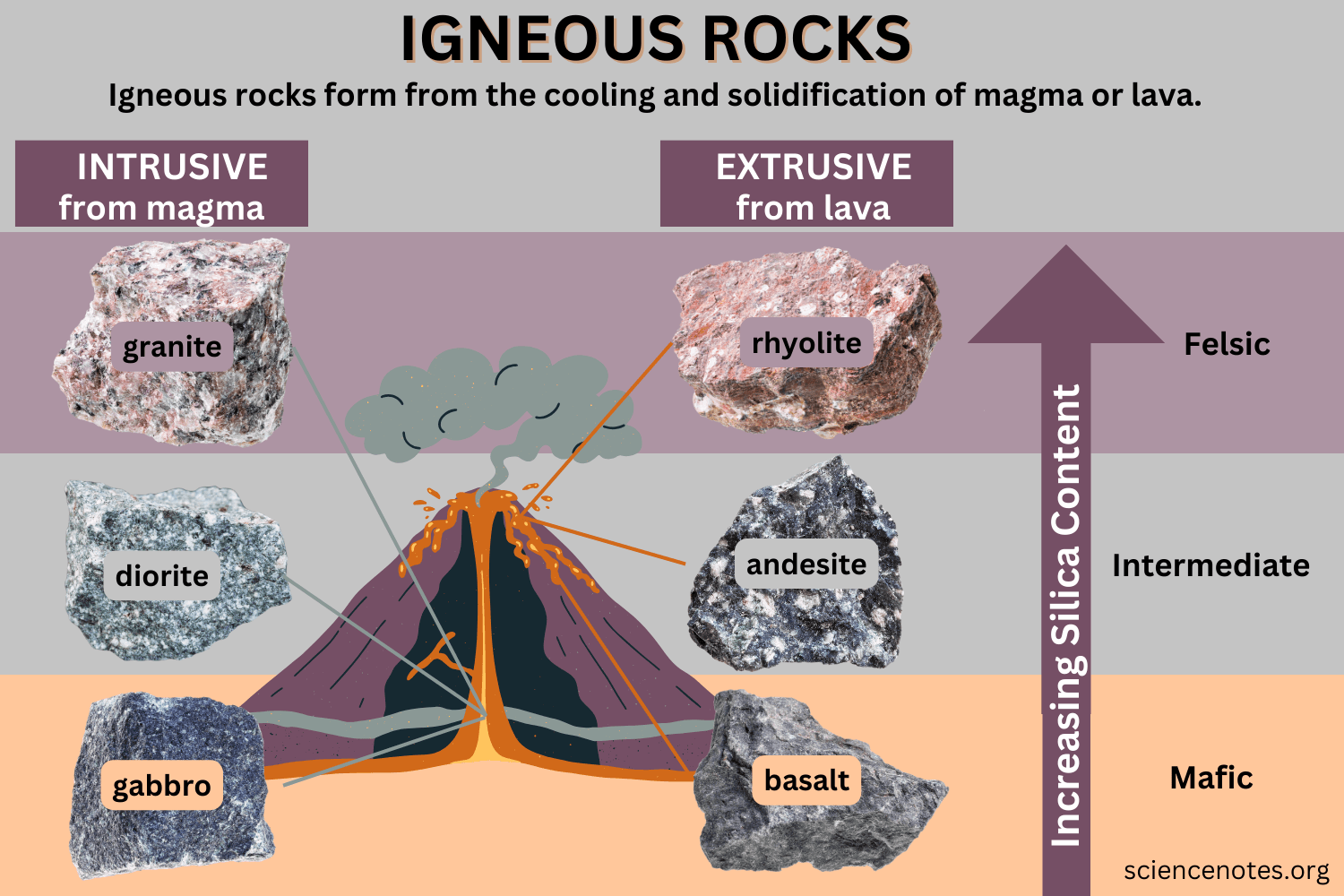
Here’s the secret that geologists don’t shout from mountaintops (maybe because they’re busy studying them): lava is just magma that escaped. Imagine magma as a shy hermit living deep underground, all hot and bothered under the Earth’s crust. Lava is that same hermit after he bursts out of his cave, screams into the open air, and melts everything in sight.
So when we talk about igneous rocks, we have to ask: did this stuff cool down inside the Earth, or outside? That tiny detail changes everything—from the rock’s texture to its personality. Magma that stays put? That makes intrusive rocks. Magma that becomes lava and spills out? That makes extrusive rocks.
The "Lava Only" Club: Extrusive Rocks
When lava hits the surface, it cools down fast, like a kid who realizes the ice cream truck is leaving. This speedy chill means crystals don’t have time to grow big and fancy. So extrusive rocks—like obsidian (that shiny, black, glassy stuff) or pumice (the rock that floats in your toilet, no joke)—look smooth or bubbly.
Obsidian is basically frozen lava, and it’s so sharp that ancient people used it for arrowheads. Pumice, on the other hand, is lava that got so gassy it looks like a sponge. Yes, lava makes floating rocks. Try dropping a pumice in your pool—it’s a party trick that won’t sink.
But here’s the kicker: these rocks are made from lava. So if you only hang out with extrusive rocks, you’d think, “Yep, all igneous rocks come from lava.” But you’d be missing the other half of the story—the sneaky, underground kind.
The Underground Bunch: Intrusive Rocks
Now imagine magma chilling miles beneath your feet. It’s surrounded by other hot rock, so it cools agonizingly slowly—like a sloth on vacation. This slow cook allows crystals to grow huge, forming rocks like granite (think kitchen countertops) or gabbro (the dark, chunky stuff under the ocean).
Granite is the poster child of intrusive rocks. It never saw the light of day until a glacier or a road crew dug it up. Its big, visible crystals are a dead giveaway: “Hey, I cooled inside the Earth, not on some volcanic beach.” So, no lava involved—pure, underground magma.
And get this: you can have the exact same chemical recipe for an intrusive and an extrusive rock, but they’ll look totally different. Rhyolite (extrusive) and granite (intrusive) are chemical twins, but rhyolite is fine-grained and glassy, while granite is chunky and sparkly. It’s like comparing a hastily baked cupcake to a slow-churned ice cream cake—same ingredients, totally different vibes.
 Aphanitic (a = not, phaner = visible) rocks in contrast to phaneritic
The Confusing Middle: When Magma Almost Escapes
Life gets messy, and so do rocks. Sometimes magma travels almost to the surface but gets stuck in a crack—forming a dike or a sill. These are like the “hybrid cars” of the igneous world: they cool a bit faster than deep magma, but slower than lava. You’ll get a mix of tiny and medium crystals.
These in-between rocks, like porphyry, have big crystals (from slow cooling) surrounded by small grains (from faster cooling). It’s like finding a giant marshmallow in a batch of tiny cereal puffs. And no, they’re not made from lava either—just magma that took a wrong turn.
So, Are All Igneous Rocks Made From Lava?
No way, José. Only the extrusive ones—the ones that erupt—are lava babies. The intrusive ones are magma’s cool, underground cousins. To say all igneous rocks come from lava is like saying all bread comes from toast. Toast is one version of bread, but the doughy, unbaked loaf is just as legit.
Think of it this way: if you meet a rock with tiny or no crystals (like obsidian or pumice), it’s a lava rock. If you see big, chunky crystals (like granite), it’s a magma rock. And if you’re really confused, just lick it—kidding, don’t lick random rocks. Trust your eyes instead.